
Redesign one workflow.
When my scheduled deep-work block arrives, I will work the redesign of our chosen workflow, roles before tools.
How consistently did you work the redesign this week?
13/30 days complete 2/5 active weeks Checked in

 The 4 Stages of Psychological Safety™
  The 6 Domains of Emotional Intelligence™
  Coaching & Accountability Matrix™
  EPIC Change & Transformation™
  DECIDER Critical Thinking™
  Team Cohesion & Performance™
  Leading Through AI™
AI Leadership · Leading Through AI™
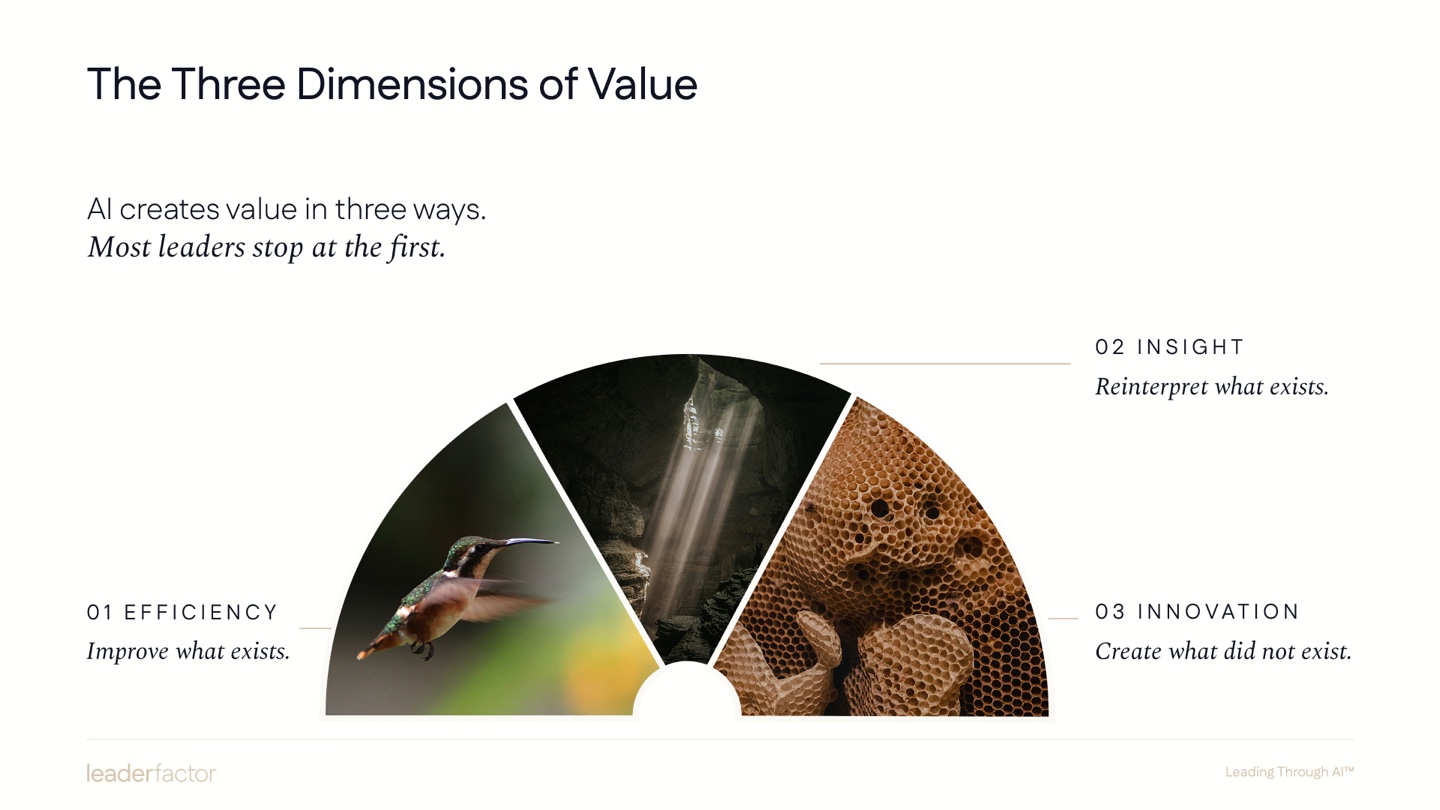
AI is changing what your people do — and clarifying what only leaders can do. Leading Through AI™ builds the judgment layer: what to own, what to augment, what to automate, and how to prove the value.
Leading Through AI™ is LeaderFactor's AI leadership course for executives and managers, measured with the AI Leadership Index.
Before you scroll
Eight questions and we’ll tell you. You’ll get a read on where your team is stuck, why, and the format we’d recommend. Skip it if you want; the full page is below.
Define
I can name which parts of my team’s work we should own, augment, and automate.
Discover
We know where the real work happens — not just what the org chart says.
Design
We’ve redesigned at least one workflow around AI — not just bolted a tool onto the old one.
Develop
Our pilots get reps and support — adoption doesn’t die after the demo.
Demonstrate
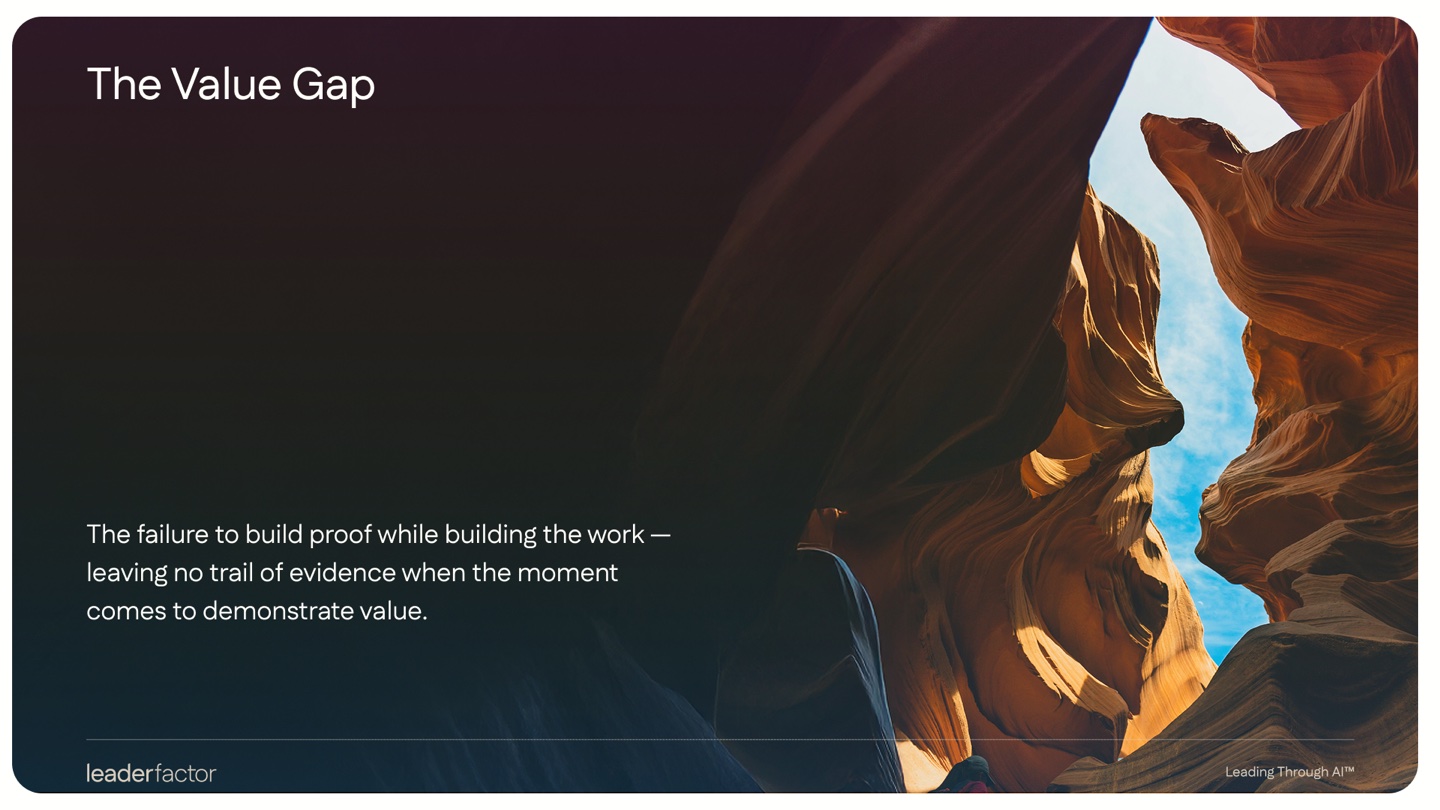
We can show what our AI effort returned, in the language of the business.
Your goal
Why are you interested in AI Leadership?
Scope
Who is this for?
Delivery
How do you picture it running?
Fit
How custom to your organization does this need to be?
Your read
Your format
Off the shelf fits you.
The AI Leadership course as it ships — the same curriculum, assessment, and tools you can see in the demo below.
Preview the course →Off the shelf, tuned to your needs.
The standard program with tuning — cohorts, sequencing, and delivery matched to how your org actually runs. That’s a conversation, not a form.
Talk with us →A custom build.
Your content and brand on our instructional system and platform — see how custom courses come together.
See custom builds →Start with the free resources.
For your own development, the free path goes deep — field guides, the podcast, and course previews, no purchase required. When you’re ready to bring it to a team, we’re here.
See the free resources →Certifying your own facilitators? See how certification works.
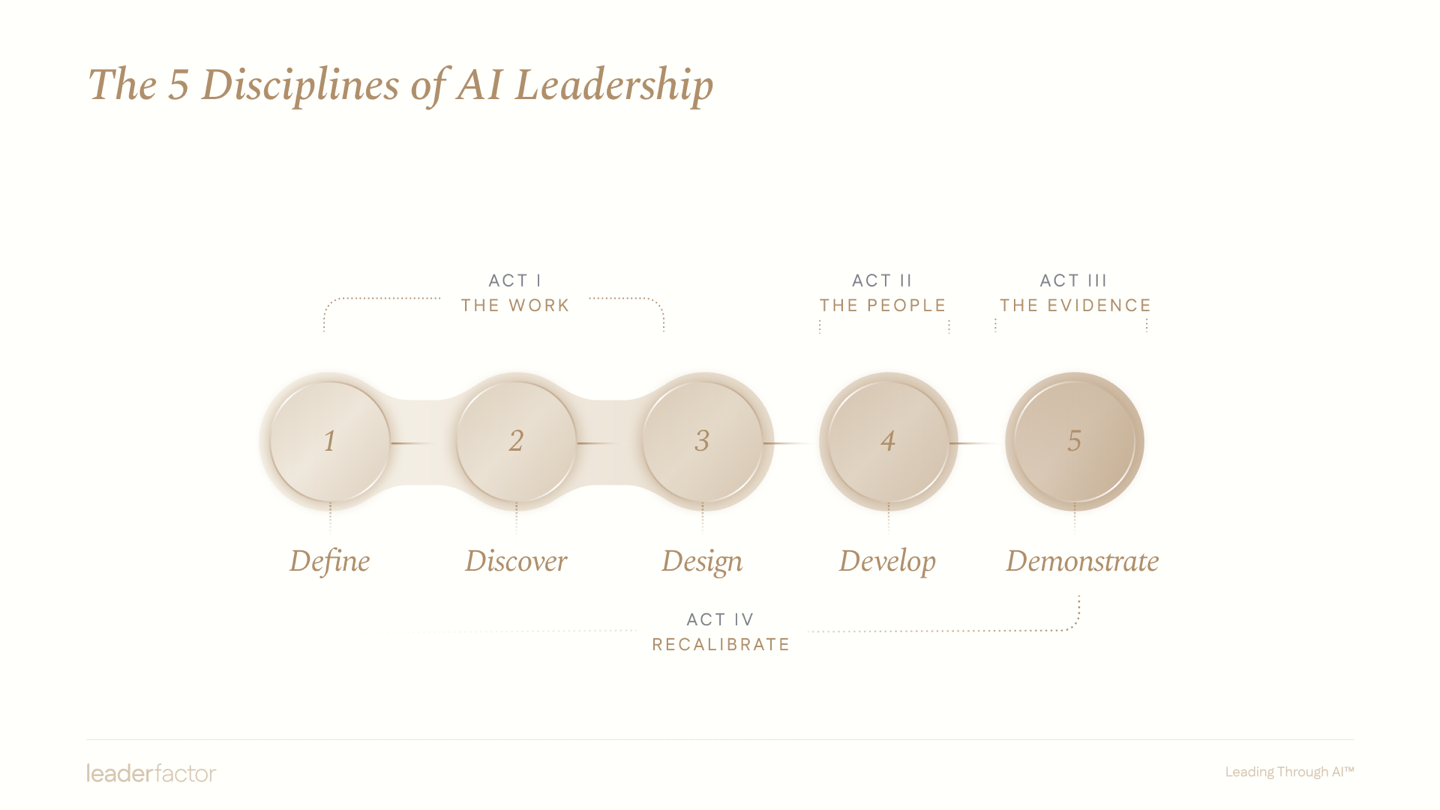
Lead workflow redesign, adoption strategy, and proof of value with one operating discipline. The model is the diagnosis, the curriculum, and the shared language.
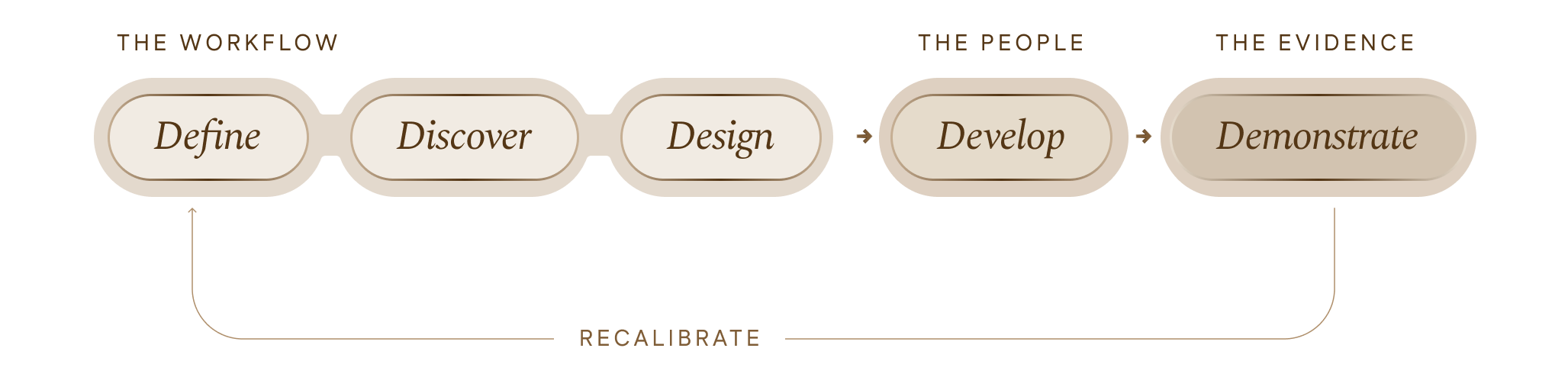
The 5 Disciplines ofAI Leadership™
Define
Name the outcome and the workflow you're actually changing.
Discover
Find where the work really happens — not where the org chart says it does.
Design
Redesign the workflow around the capability, not the demo.
Develop
Build, pilot, and instrument. Reps, not theory.
Demonstrate
Prove value in the language of the business — then scale it.
Why we're here
Name the AI leadership gap, the work that's truly yours to hold, and the 5D operating discipline — then baseline it with the AI Leadership Index.
Define
Audit the real composition of your work, sort it into own, augment, and automate, and set a clear leadership thesis.
Discover
Push past obvious efficiency wins to a possibility map, then commit to one concrete opportunity worth pursuing.
Design
Redesign the workflow around the capability — clear human and AI roles — and justify a single pilot plan.
Develop
Work the adoption paradox: identify stakeholders, assess readiness, and build the support that makes new ways of working stick.
Demonstrate
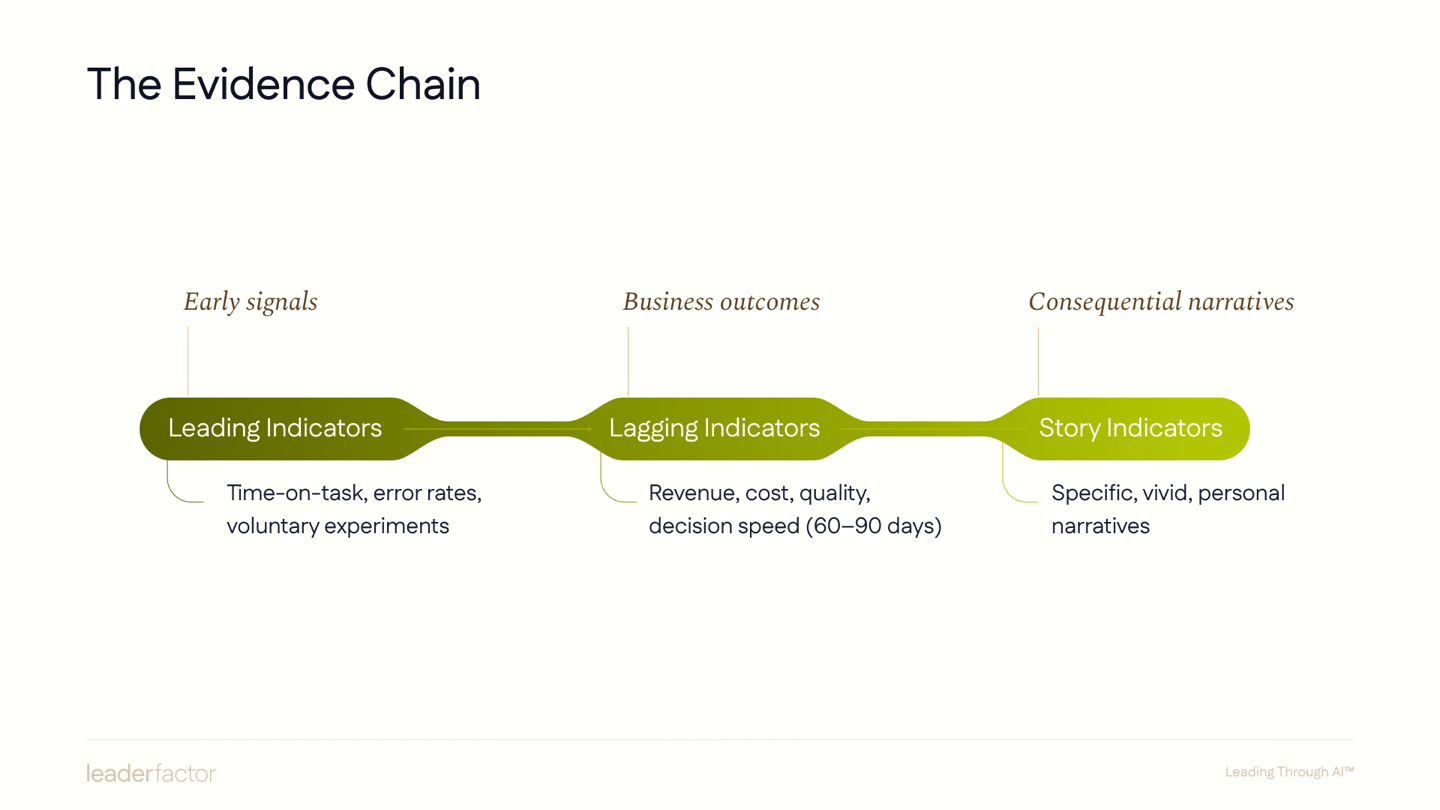
Build a 90-day proof plan with leading, lagging, and narrative evidence, then make a credible scale-or-refine call.
Your 5D operating roadmap
Assemble the modules into one executive-grade operating document and re-take the AI Leadership Index to measure the shift.
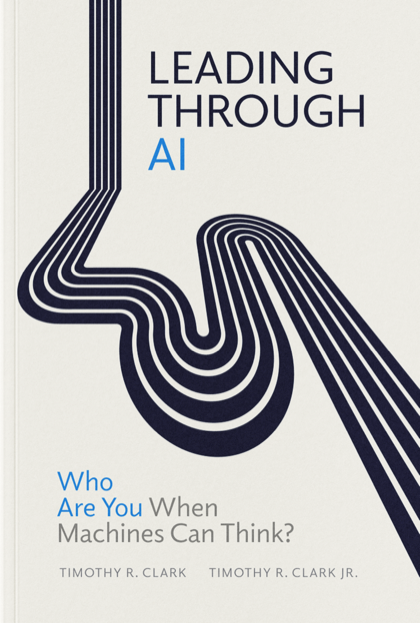
By Timothy R. Clark & Timothy R. Clark Jr.
Leading Through AI: Who You Are When Machines Can Think is the thinking behind this course. Read the argument, then run the system.
The course isn’t content — it’s a sequence. Each stage does something the next one depends on.
Assess
See it before you change it.
Development starts from the truth, not a hunch. Every learner baselines with AI Leadership Index — where they’re strong, where they’re stuck — so the course lands on a real gap instead of a generic lesson.
Learn
Learn it against your own results.
Lessons tie the framework to the learner’s own scores, and built-in reflection does the encoding — people remember what they connect to their own team, not what they’re told.
Commit
Practice until it’s habit.
Knowing doesn’t change behavior — practice does. Learners leave with “when X, I will Y” commitments and a weekly consistency check-in, thirty days at a time, until it’s habit.
Toolkit
Keep the skill in the flow of work.
The Learner Toolkit turns the framework into a tool learners reuse on real AI pilots — interactive and repeatable, so the skill compounds after the course instead of fading.
Built for L&D and HR leaders evaluating for their organization: a one-hour live session with our team, plus a free Access Pass to experience the real thing yourself — your actual results, not a sample.
Click through what a learner experiences — and what your facilitators and admins run.
Day 0 Take AI Leadership Index — your self-assessment baseline. Truth first, not a hunch.
I can name which parts of my team’s work we should own, augment, and automate.
Facilitator certification
Keep going to complete your certification.
Program roadmap · FY26
Upcoming
Also scheduled: People leaders · wave 2 (140 · live-virtual · Q3) and All teams (900 · on-demand · Q4).
Delivery · people leaders, wave 1
Live-virtual
Next session Thu · 32 enrolled
Facilitated by your certified team
In person
On-site workshop · Oct 12
Your facilitators or LeaderFactor experts
On-demand
210 active learners
Self-paced, same curriculum and assessment
Presenter mode
Presenting · live-virtual
Design · Lesson 3
Why tools inherit your process problems
Bolting AI onto an old workflow automates the old workflow’s problems.
Which of your team’s AI uses is a redesign — and which is a bolt-on?
Drafting is a real redesign; review moved to editing. But our reporting “automation” is the same report with extra steps.
Pick one recurring task and redesign it around the capability this week — roles first, tool second.
Add a workflow · step 1 of 5
Chosen responsibility
Uinta suggests
Add a workflow · step 2 of 5
AI prep brief for planning tradeoffs
AI predicts: Augment
Planning tradeoffs depend on human judgment and relationships — AI can prepare the ground, not make the call.
Pilot · step 1 of 3
Pick the signal that best describes what a successful pilot looks like at 60–90 days.
Or write your own
Pilot · step 2 of 3
Pilot objective
✎ EditTest whether an AI prep brief can turn planning notes into a clearer tradeoff conversation that reduces rework.
Baseline
✎ EditToday, leads spend 2–4 extra days reconciling dependencies before a draft is ready — and most drafts need another loop.
Success signals
✎ EditFirst drafts settle in one review instead of two or three, within the pilot window.
Pilot · step 3 of 3
Human does
Own the final planning call when scope or risk is ambiguous.
Review the AI draft with design and eng leads.
+ Add bullet
AI does
Turn planning notes and dependencies into a first-pass tradeoff brief.
Surface likely conflicts and risky orderings.
+ Add bullet
Guardrails
Human sign-off before the brief reaches planning.
Fall back to the manual review if confidence is low.
+ Add bullet
Success looks like
First drafts settle in one review instead of three.
Tradeoff discussion replaces basic clarification.
+ Add bullet
Saved to your possibility map — 15 future workflows and counting. Start the pilot when you’re ready.
AI Leadership Index · individual
Dimension breakdown
Can I name what we own, augment, and automate?
Your self-baseline — the re-take at 90 days shows the movement.
Do I know where the real work happens?
Your self-baseline — the re-take at 90 days shows the movement.
Do we redesign workflows, not bolt tools on?
Your self-baseline — the re-take at 90 days shows the movement.
Do our pilots get reps and support?
Your self-baseline — the re-take at 90 days shows the movement.
Can I show what AI returned, in business terms?
Your self-baseline — the re-take at 90 days shows the movement.
In their words · qualitative
“Where did your last AI initiative actually stall?”
After the demo. Everyone was impressed and nobody changed how they work.
Proving it mattered. Usage went up; I couldn’t say what the business got.
“What’s working?”
Picking one workflow and finishing it. Our intake process is genuinely different now — that one is real.
Illustrative sample data, normalized to 0–100 for display — each instrument reports on its own scale.
In the flow of work
Redesign one workflow.
When my scheduled deep-work block arrives, I will work the redesign of our chosen workflow, roles before tools.
How consistently did you work the redesign this week?
Evidence over anecdotes.
When I report on our AI pilot, I will lead with one business metric, not a usage stat.
How consistently did you lead with evidence this week?
Start working on a new commitment
You have 12 planned skills — time to get started.
Planned commitments
Saved for later. When you're ready, move one to your plan. AI Leadership 52/100 Change Management 59/100 AI Leadership Index · aggregate reporting
Pre / post by stage
Baseline 90-day BenchmarkBenchmark = the AI Leadership Index research base across participating organizations.
Participation & engagement
474 invitedBy cohort
4 cohorts · 3 modalitiesIllustrative sample data, normalized to 0–100 for display — each instrument reports on its own scale.

Certification
Certify your own people once, and deliver it to every Access Pass cohort on your own cadence — same curriculum, decks, and facilitator resources our experts use.
One pass per learner covers the whole system for this skill — assessment, course, tools, and reporting. Certification and delivery options layer on top.
Full Access Pass details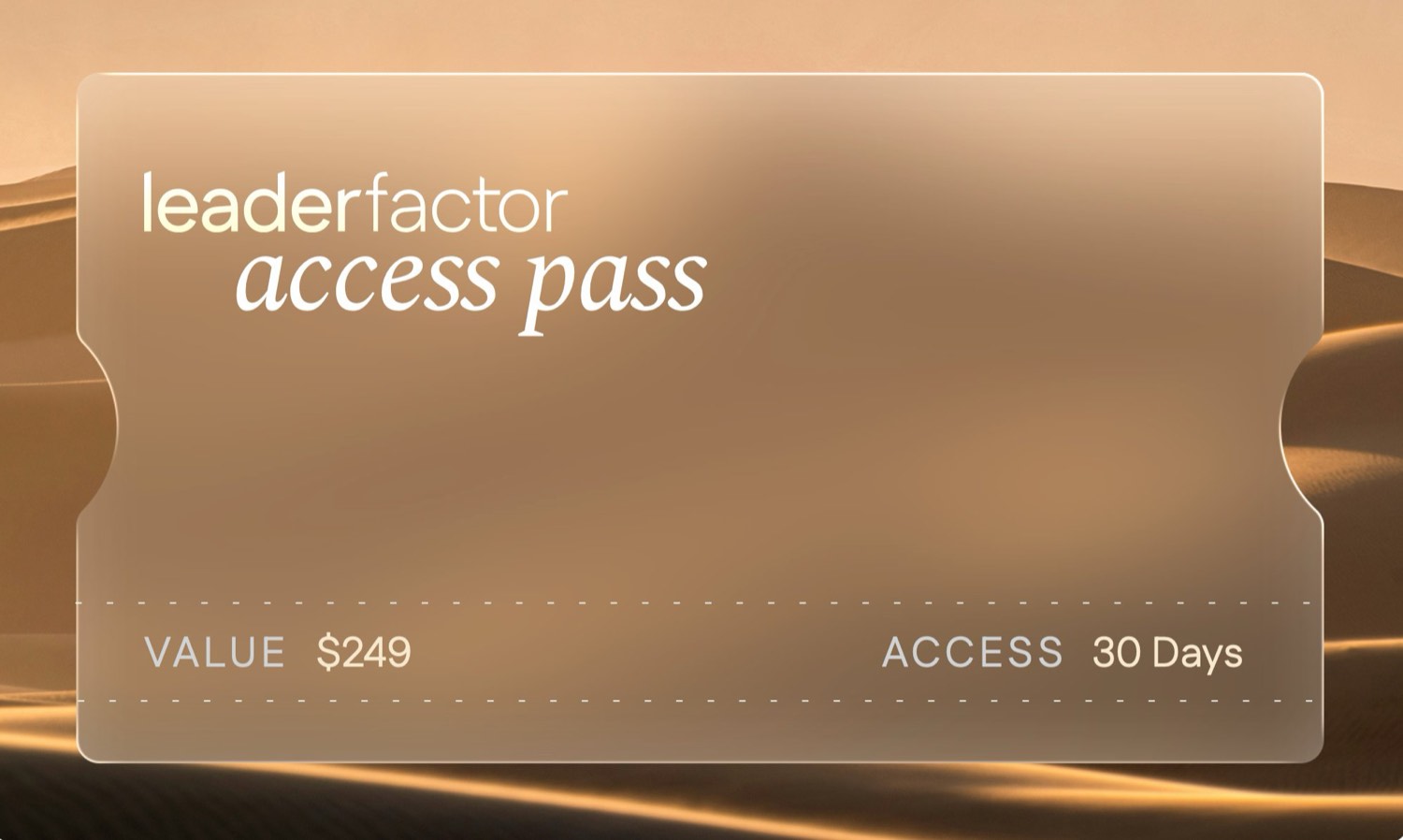
Field guide
The Leader’s Guide to an AI-Legible Organization
Make your organization legible to AI — and your leadership legible to your people.
Read the guide
Podcast
The Leader Factor
Dr. Tim Clark and Junior on the frameworks behind the work — weekly, candid, and free.
Listen inLibrary
All field guides
Every downloadable guide across the seven skills — no email wall on the reading.
Browse the libraryAI leadership training develops the judgment leaders need to get value from AI — which is different from AI training that teaches tools. Tools change quarterly; the leadership work doesn't: deciding what to own, augment, and automate, redesigning workflows around the capability, driving adoption past the pilot, and proving value in business language. That operating discipline — the 5D model — is what this program builds.
Start with the work, not the tool. Leaders audit what their team actually does, choose one workflow worth redesigning, and pilot it with clear human and AI roles. Then they work the adoption paradox — the people closest to the work often have the most to gain and the most hesitation — with readiness assessment and visible support. Finally they prove value with a 90-day evidence plan, so adoption survives contact with the budget cycle.
It's a system, not an event. The proprietary 5D framework and the AI Leadership Index drive behavior change in how leaders lead through AI, and it's tool-agnostic — so it outlives any single model or vendor rather than teaching this quarter's app.
Each leader takes the AI Leadership Index self-assessment up front to set a baseline, applies the discipline to live workflows during the program, then re-takes it at the end — so you can measure the shift and see where leaders moved, not just whether they attended.
Run it self-paced, as a facilitator-led cohort, or certify your L&D team to deliver it at scale. It runs on leaderfactor.app, so enrollment, cohorts, the assessment, and reporting live in one platform your admins manage.
Custom builds
Your frameworks, your language, your brand — built into a custom course on the same instructional system, assessment engine, and platform that runs Leading Through AI™.
Ninety seconds tells you where to start. A conversation tells you how fast you can get there.
or take the ninety-second intake ↑